
Introduction to the Akka Actor Model: Building High-Concurrency Distributed Applications
Akka is an open-source toolkit for building highly concurrent distributed applications. Its core Actor model simplifies the complexity of concurrent programming and distributed system development through message passing and state encapsulation.
In modern software development, building high-concurrency, distributed application systems faces many challenges: the complexity of multithreaded programming, the unreliability of network communication, and the need for system scalability, among others. Akka, as an open-source toolkit based on the Scala language, provides us with an elegant solution—the Actor model.
What is Akka
Akka is a powerful open-source toolkit specifically designed to simplify the development of high-concurrency, distributed, fault-tolerant, and highly scalable applications. It primarily addresses the following key issues:
- Multithreading Complexity: Provides an abstraction for multithreaded behavior, shielding the underlying distributed structure and memory visibility issues.
- Network Communication: Implements remote transparent communication between systems and components, avoiding the need to write and maintain complex network code.
- System Resilience: Offers a resilient, highly available cluster architecture design that supports on-demand scaling.
Core Concepts of the Actor Model
What is an Actor
An Actor is an object that encapsulates state and behavior, communicating through messages. Unlike traditional object-oriented programming, Actors are isolated from each other, do not share memory, and messages are immutable objects. This design allows Actors to avoid concerns related to locks and memory atomicity, which are common issues in multithreading.
Components of an Actor
Each Actor consists of three core components:
1. State
- Internal variable information of the Actor.
- Can only be accessed and modified by the Actor itself.
- Ensures data encapsulation and safety.
2. Behavior
- The corresponding computation logic executed by the Actor upon receiving a message.
- Defines how the Actor responds to different types of messages.
- Can change the Actor's state based on the content of the message.
3. Mailbox
- A queue that stores messages sent to the Actor.
- By default, each Actor corresponds to an independent mailbox.
- Messages are processed serially in order.
- For the same "sender-receiver" combination, messages maintain order.
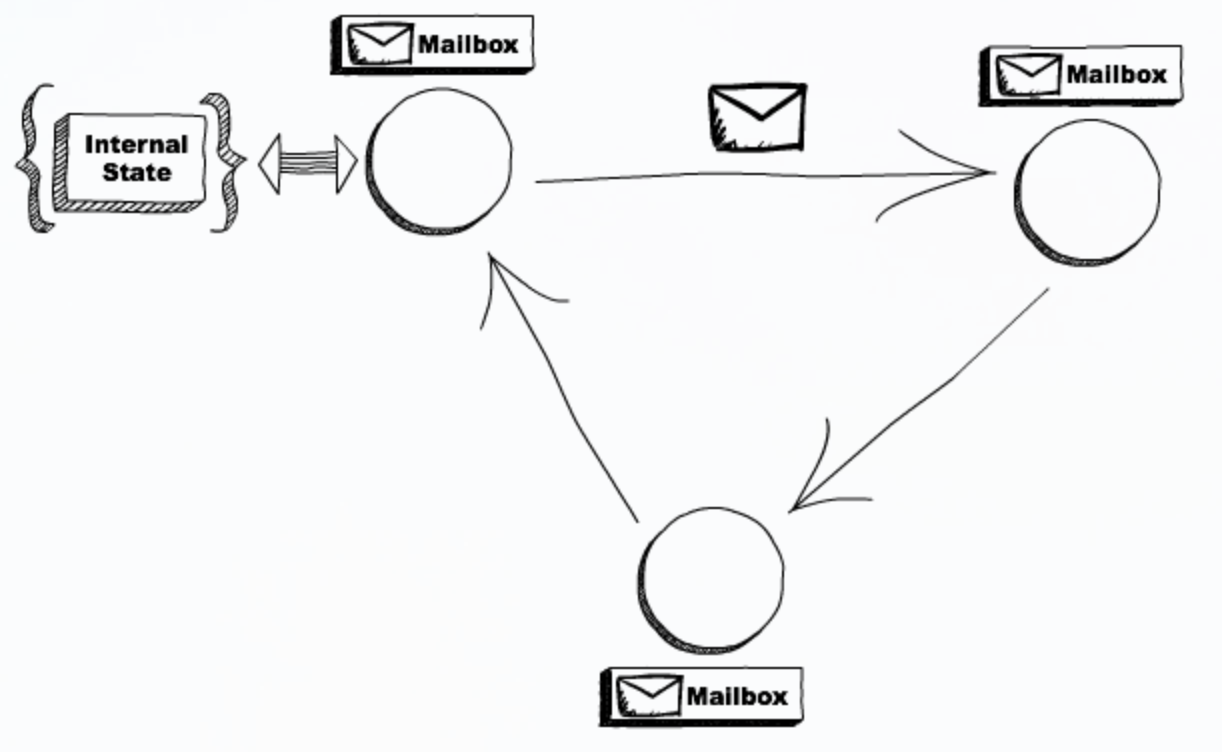
Actor System Architecture
Tree Structure Organization
Actors are organized in a tree structure, which brings a clear hierarchical relationship:
- Root Node: Three top-level Actors (root, user, system) are created when the Akka system starts.
- User Actors: All Actors created by users are located under the
/usernode. - Parent-Child Relationship: Each Actor can create child Actors to handle split computation tasks.
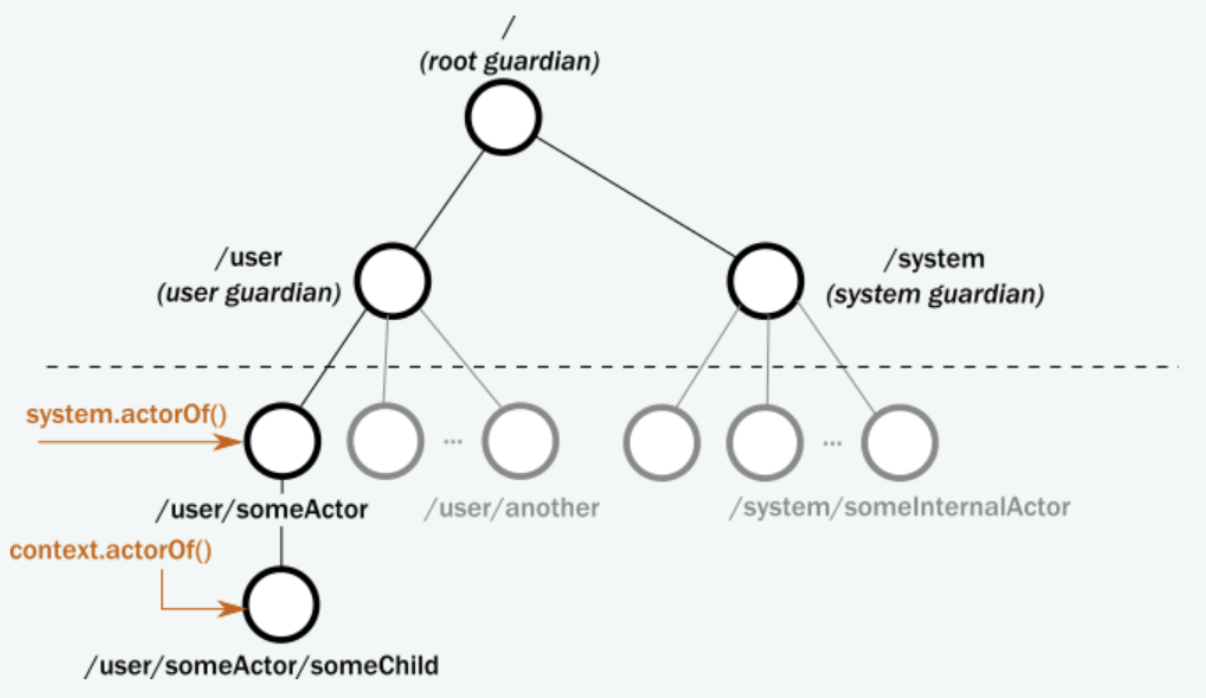
Supervision Strategy
The tree structure also supports Akka's supervision strategy:
- When an Actor fails (throws an exception), it suspends itself and its child nodes.
- Failure information is notified to the parent node for handling.
- If the parent node cannot handle it, the information propagates to the upper-level nodes.
- This design ensures the system's fault tolerance and self-healing capability.
ActorRef: Location Transparent Reference
What is ActorRef
ActorRef is a reference to an Actor, whether that Actor is a local actor in the local JVM or a remote actor on another machine in the network. Through ActorRef, messages can be sent to an Actor without worrying about the Actor's specific location, which is known as location transparency.
Ways to Obtain ActorRef
1. Obtained at Creation
val actorRef = system.actorOf(Props[MyActor], "myActor")val actorRef = system.actorOf(Props[MyActor], "myActor")2. Path Lookup
val selection = system.actorSelection("/user/myActor")val selection = system.actorSelection("/user/myActor")Sender Reference
When processing messages, an Actor can access the reference of the current message sender through the sender() method, facilitating reply operations.
Message Sending Mechanism
Akka provides two ways to send messages:
1. Tell Method (Recommended)
- Characteristics: "fire-and-forget" mode.
- Behavior: Sends a message asynchronously and returns immediately.
- Applicable Scenarios: Situations where no response is needed.
actorRef ! messageactorRef ! message2. Ask Method
- Characteristics: Sending messages that expect a reply.
- Behavior: Sends a message asynchronously, creating a temporary Actor and Future to handle the reply.
- Requirements: A timeout must be set.
- Applicable Scenarios: Situations where the processing result is needed.
val future = actorRef ? messageval future = actorRef ? messageMessage Delivery Guarantee
It is important to note that in Akka, messages follow the at most once delivery principle, meaning there is no guarantee that messages will be delivered to the target Actor.
Dispatcher
Role
The Dispatcher is a core component that maintains the operation of Akka Actors, responsible for allocating Actors and messages in the mailbox to threads for execution.
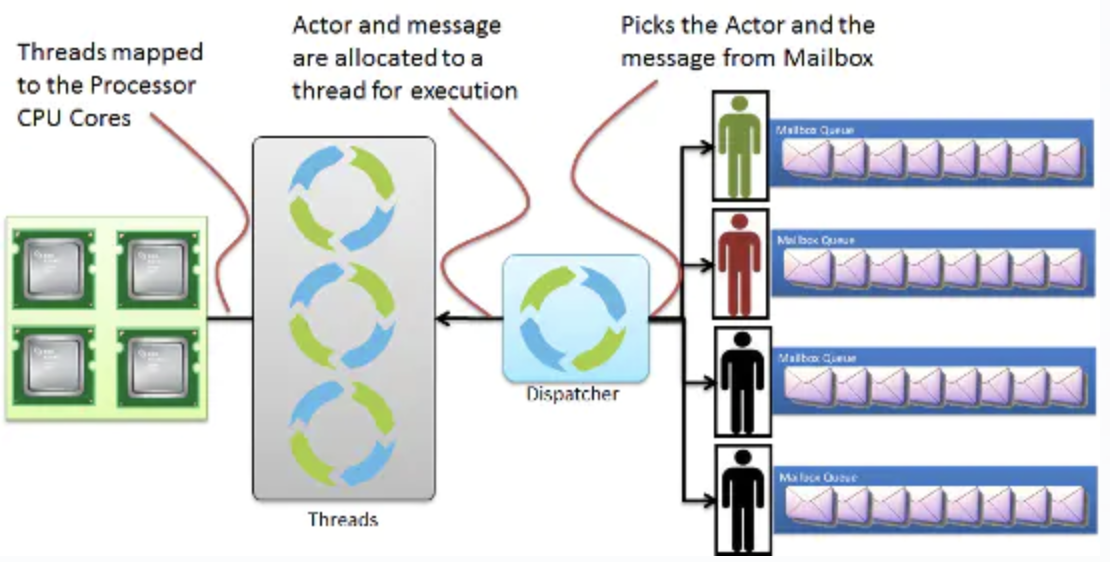
Types of Dispatchers
1. Dispatcher (Default)
- Binds a group of Actors to a thread pool.
- Suitable for most application scenarios.
- Provides good performance and resource utilization.
2. PinnedDispatcher
- Each Actor has an independent single-threaded thread pool.
- Suitable for scenarios requiring thread isolation.
- Higher resource consumption.
3. BalancingDispatcher
- Creates an independent thread for each Actor.
- All Actors share a single mailbox.
- Suitable for work-stealing scenarios among similar Actors.
4. CallingThreadDispatcher
- Does not create new threads; executes in the calling thread.
- Mainly used in testing environments.
- Facilitates debugging and unit testing.
Practical Application Scenarios
The Actor model is particularly suitable for the following application scenarios:
- High-Concurrency Web Services: Each request can be handled by an independent Actor.
- Distributed Computing: Large tasks can be split among multiple Actors for parallel processing.
- Real-Time Data Stream Processing: Actors can serve as processing nodes in data streams.
- Game Servers: Each player or game room can be represented by an Actor.
- IoT Device Management: Each device corresponds to an Actor for state management.
Conclusion
The Akka Actor model provides a complete solution for building high-concurrency distributed applications through message passing, state encapsulation, location transparency, and supervision strategies. It not only simplifies the complexity of concurrent programming but also offers excellent fault tolerance and scalability.
Comments
No comments yet. Be the first to comment!